
You’ve got your eye on something big. Maybe it’s a car that won’t break down every other month, a down payment on a home, or finally taking that trip you’ve been postponing for three years. The problem? Your current savings account looks about as healthy as gas station sushi.
The good news: you don’t have to finance it with debt. Millions of Americans fund major purchases with cash every year, and they’re not earning six figures. They’re using the same basic strategy that actually works—and happens to feel way better when the purchase is finally yours with zero monthly payments hanging over your head.
This guide walks you through the concrete moves you can make right now to save for that big goal without touching a credit card or taking out a loan.
Start With an Honest Target Number
Before you can save effectively, you need to know exactly what you’re saving for. “A new car” is too vague. “$18,500 for a reliable used Honda CR-V” is the number that sticks.
Write down the full amount you need. If you don’t know it yet, do the research this week—check dealer websites, real estate sites, travel booking platforms, whatever applies. You need a concrete figure, not a ballpark guess.
Now add 10-15% as a buffer. Things cost more than you think. Inspection fees, shipping, taxes, the random upgrade you’ll suddenly want when you’re this close. Building in that cushion keeps you from getting 90% to your goal and then resorting to debt when reality costs 10% more.
Once you have your number, divide it by how many months you’re willing to wait. If you need $20,000 in two years, that’s roughly $833 per month. If you can do it in three years, it drops to $556 monthly. This mental math makes an abstract goal feel achievable.
Cut One Category Ruthlessly—and Redirect It
Most people fail at saving because they try to squeeze an extra $50 from everywhere: skip one coffee, eat out one fewer time, cancel one subscription. You end up tired from the nickel-and-diming and the total never adds up.
Better strategy: pick one spending category and cut it hard. Not for life—just until you hit your savings goal.
Common high-impact cuts:
Subscription services — the fastest win. Most Americans have 5-10 active subscriptions they forgot about. Streaming services, fitness apps, meal kits, software trials. Audit your credit card statement right now. You’re probably looking at $50-150 monthly you didn’t even notice bleeding out. Cancel everything except maybe two services you actually use weekly.
Dining out and delivery — if this is your weak spot, it’s also your goldmine. Eating lunch out five days a week can run $75-100 weekly. Bringing lunch from home drops that to maybe $10-15. That’s a $65 weekly swing, or $260 monthly. Still too hard? Reduce it to twice weekly instead of five times.
Gym membership or fitness class — especially if you joined in January and haven’t been since February. A $40-80 monthly gym you don’t use is pure waste. Pause it until after you hit your savings goal. You can walk, run, or do YouTube workouts free.
Premium versions of free apps and services — upgraded Spotify, premium phone plans, fancy insurance policies, cable packages packed with channels you never watch. Call your providers and ask what the basic plan costs. You’ll be shocked how much you’re paying for stuff you don’t need.
The psychological trick here is that cutting one category completely feels easier than cutting everything a little. You’re not constantly making small sacrifices. You pick one thing, you stop, done. And the money is real—usually $100-300 monthly depending on what you cut.
Immediately set up an automatic transfer of that freed-up money into a separate savings account (more on that below). Your brain needs to see that money leave your checking account or you’ll unconsciously spend it elsewhere.
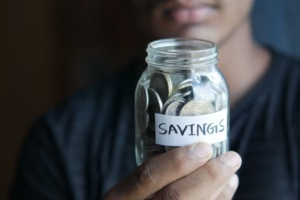
Open a Separate Savings Account Just for This Goal
Don’t save for your big purchase in your regular checking account. You’ll see that balance and think, “I could use that for X right now.”
Open a second savings account at your bank or a different bank altogether. Name it something specific: “House Down Payment” or “Car Fund” or “Greece Trip.” This mental separation matters way more than people realize.
Even better: open it at an online bank where you can’t instantly transfer money out with your debit card. Banks like Ally, Marcus, or Discover offer high-yield savings accounts where your money actually earns interest while you’re saving. We’re talking 4-5% annual return right now, which means a $10,000 balance grows to $10,400-500 just sitting there for a year. It’s free money while you’re already being disciplined about saving.
Set up automatic transfers to happen on payday, right after you get paid. If your paycheck hits on the 15th, schedule that $500 or $833 to move to your goal account on the 16th. Out of sight, out of mind. You’ll be shocked how fast the balance grows when you’re not watching it obsessively.
Find a Second Stream of Money (Don’t Touch Your Regular Savings)
Here’s the mistake most people make: they sacrifice from their regular budget and call it a day. That’s fine, but it’s also slow.
The shortcut? Find a completely separate pocket of money that doesn’t touch your normal spending at all.
Where to find this money:
Tax refunds — if you’re getting a big refund every year, you’re essentially giving the IRS an interest-free loan. But since most people get a refund anyway, it’s “found money” that doesn’t feel like a sacrifice. Commit right now to putting 100% of next year’s refund into your goal account.
Bonuses, raises, or side income — when you get a raise at work, your impulse is to spend it. Don’t. Commit half of any raise or bonus straight to savings. Your lifestyle doesn’t change, but your goal gets a boost.
Selling stuff you don’t use — a shocking number of people have closets, garages, and storage units full of things. Clothes that don’t fit, electronics you upgraded from, furniture you’re tired of. List it all on Facebook Marketplace, Craigslist, or eBay. You’d be surprised—people will pay for your old stuff. One person’s $3,000-5,000 garage cleanout becomes their $3,000-5,000 progress toward a car down payment.
Seasonal work or a small side hustle — you don’t need to become obsessed with side income. But picking up work during busy seasons (holiday retail, tax time, seasonal projects) or freelancing five hours a week in something you’re already good at can generate $200-400 monthly. Every penny goes straight to your goal.
Cashback and rewards — if you’re already using a credit card for regular spending (and paying it off monthly), you’re throwing away cashback. Redirect your entire credit card rewards into your goal account. It’s not much—maybe $50-100 monthly depending on your spending—but it stacks.
The point: find at least one external source of money that doesn’t require you to sacrifice your current lifestyle. It accelerates the timeline significantly.
Track Your Progress Weekly
You need to feel momentum. Watching your balance grow is incredibly motivating and keeps you from giving up when you’re only three months in.
Every Sunday, log into your goal savings account and write down the balance. Use a simple Google Sheet or notepad to watch the number climb. Most people find this genuinely exciting—especially around month four when you can see you’re actually on pace to hit your target.
When you’re halfway there, celebrate it. This is real progress. You’ve proven to yourself that you can stick to something. When you’re at 75%, start thinking about the logistics of the actual purchase—test driving cars, visiting neighborhoods, booking accommodations, whatever applies.
This tracking also catches problems early. If you’re three months in and barely moved the needle, you know your $833-per-month target was unrealistic and you need to either extend your timeline or find another income source. Better to know that now than get discouraged six months in.
Stay Committed When Temptation Hits
Somewhere around month three or four, temptation will arrive. You’ll want to use that money for something else—an emergency comes up, you see something on sale, a friend invites you on a trip.
Here’s the truth: some emergencies are real. Your car breaks down catastrophically, you need a medical procedure, your roof leaks. That’s what emergency funds are for, which is separate from your savings goal fund. If you don’t have an emergency fund yet, start with $1,000-2,000 in a separate ultra-safe account, then attack your big purchase goal.
For the non-emergencies—the sales, the impulses, the social pressure—have a simple rule: you cannot touch this money. Period. Not even once. Because one dip becomes two dips becomes “I guess I’m not saving for this after all.”
When temptation hits, remind yourself of the exact moment you’ll use this money. Visualize it. Sit in that car. Walk through that house. Lie on that beach. Your future self is already grateful that current you didn’t blow it on something forgettable.
Your Next Move Today
Pick your big purchase and write down the exact dollar amount you need.
Then choose one spending category to cut ruthlessly.
Finally, open a separate savings account and set up your first automatic transfer for payday this week.
That’s it. Three actions, done today. Everything else flows from there. You’re not getting a loan, you’re not racking up credit card debt, and in six months or eighteen months you’ll have something that’s entirely yours—paid for, stress-free, and earned by your own discipline.
What’s the big purchase you’re saving for? Drop it in the comments.