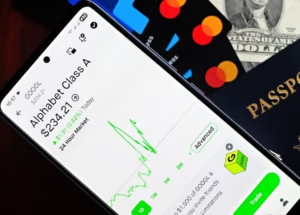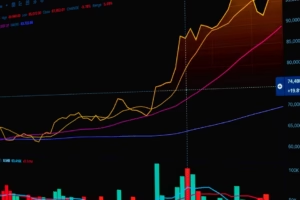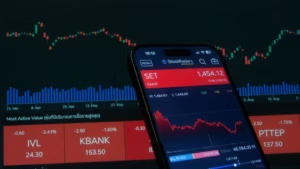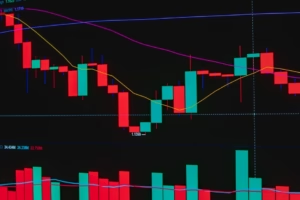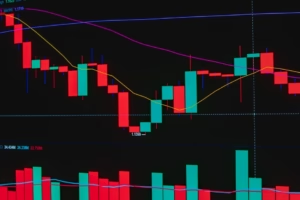

You’re scrolling through your brokerage app on a Tuesday morning when you notice the market is up big. You dig into the news and find out a high-profile official just teased a potential deal that might ease global tensions. By Wednesday, the deal falls apart—or quietly fades from headlines. The market still stays elevated. You’re left wondering: did I miss the real move, or is something else going on?
This pattern repeats more often than you’d think, and it’s not random. Markets have a predictable reaction to deal rumors and geopolitical news, and understanding why it happens is essential if you want to stay calm during the noise instead of making reactive mistakes with your money.
The good news? You don’t need to chase these headlines or time these moves. But you do need to understand what’s actually happening so you can make smarter decisions about your own investments.
Why Markets React So Strongly to Rumor, Not Reality
Deal rumors move markets because uncertainty is expensive.
When there’s geopolitical risk—think tensions affecting oil supplies, trade routes, or military spending—investors price in the worst-case scenario. That means stock valuations, bond yields, and commodity prices all reflect a “risk premium.” When a potential deal is announced, even as just a possibility, that risk premium shrinks overnight. Investors don’t need the deal to be done to buy in. They just need it to be possible.
Here’s the mechanics: crude oil futures drop because traders worry less about supply disruption. Defense contractor stocks might jump because uncertainty around military spending eases. Tech stocks rise because a cheaper energy environment is better for corporate margins. It all happens in minutes.
The catch? The market is pricing in hope, not certainty. Once you realize that a rumored deal has a 50% chance of happening, you understand why the market moved up but also why it might not stay up if the deal never materializes.
The Pattern Nobody Talks About: Why the Bump Often Sticks
Here’s where it gets interesting—and a little frustrating if you’re trying to time things perfectly.
When a deal rumor causes the market to jump, and then the deal doesn’t happen, you might expect the market to fall back down. Sometimes it does. But often, it doesn’t. Here’s why:
The market has already absorbed the positive psychology. Once investors have bought in on the “good news” scenario, institutions and retail traders don’t want to admit they were wrong by selling it all back. Instead, they hold. Individual stocks in sectors that benefited often see their gains “stick” because enough people have repositioned their portfolios.
Real economic improvements don’t need the deal to complete. If geopolitical tensions ease just from the conversation about a deal, companies might cut back on hedging costs, insurance, or contingency planning. Those savings show up in earnings even if the deal never closes.
New money keeps entering. By the time you’re reading about a deal rumor in mainstream news, sophisticated investors have already positioned themselves. Fresh money from retirement accounts, index funds, and passive investing keeps flowing into stocks regardless of whether the deal happens. That creates a floor under prices.
This doesn’t mean you should chase these moves. It means understanding that markets often price in a “best case” and then find reasons to keep most of those gains, even when the “best case” doesn’t arrive.
The Mistake Most People Make with Geopolitical News
The biggest error happens when individual investors try to trade around these moments.
You see the rumor. You panic-buy or panic-sell. Then you’re stuck holding a position when the news settles, and you realize you paid top dollar for something ordinary. Or you sold too early and missed gains that stuck around longer than expected.
Here’s the real problem: You’re competing against algorithms, hedge funds, and professionals whose entire job is reading tea leaves faster than you can. You’re not beating them to the punch. You’re buying after they already bought and the move is halfway done.
The second mistake is conflating a market rally with personal investment timing. Just because the market jumped 2% on a deal rumor doesn’t mean your portfolio is positioned right. If you’re 100% in bond funds, you didn’t benefit. If you’re in index funds, you got the market-wide bump but nothing special. Chasing the move doesn’t improve your odds—it just adds transaction costs and taxes.
How to Think About Geopolitical Volatility in Your Portfolio
Build around long-term allocations, not headlines.
Your asset allocation—the split between stocks, bonds, cash, and other investments—should be based on your time horizon and risk tolerance, not on what might happen with international negotiations. If you’re 10+ years from retirement, you should own stocks. If you’re retiring soon, you should own bonds. A rumored deal in the Middle East doesn’t change either fact.
Understand what you actually own.
Do you know whether your index funds contain energy stocks? Defense contractors? Companies with significant import/export exposure? You don’t need to micromanage, but you should know what sectors make up your portfolio. That way, when geopolitical news breaks, you can think clearly instead of wondering whether you’re exposed.
Use volatility as a feature, not a bug.
Market jumps on good news mean that good news gets priced in fast. That’s actually healthy. It means valuations incorporate new information quickly, which is better for long-term investors than slow, grinding declines based on old information. When the market rallies on a rumor and then holds those gains, it’s telling you something has genuinely improved—even if the original deal never closes.
Rebalance on emotion, not on news.
The best time to buy stocks is when they feel scary and geoopolitical risk is high. The best time to trim stocks is when everything feels great and everyone is piling in. You don’t need to do this constantly, but once or twice a year—especially after big moves—checking whether your portfolio matches your target allocation is smart. Buy low, trim high. That’s the boring stuff that actually works.
The One Thing to Watch: When Deal Rumors Stop Working
Markets can only price in so much hope before reality matters again.
If deal rumors keep coming but nothing ever materializes, eventually traders stop believing them. The market will develop what analysts call “rumor fatigue.” The next headline won’t pop the market up because investors will assume it’s just more talk.
That’s actually a sign the environment is normalizing—which is good for steady, long-term investing. It means fewer wild swings and more rational pricing.
For your portfolio, this means the volatility you see from geopolitical news is temporary. Whether the next rumor moves the market up 1% or 3%, it doesn’t change your 15-year stock market returns. It doesn’t change whether you should stay invested in your 401(k). It doesn’t change your bond allocation or your emergency fund.
What does matter is that you’re invested according to a plan and you stick to it through the noise.
Your Next Move This Week
Pull up your investment account and check one thing: Do you know what your asset allocation actually is? Not what you think it should be, but what it actually is right now.
If your portfolio is 60% stocks and 40% bonds—or whatever your target is—you’re fine. Geopolitical rumors will move the market, but they won’t move your long-term returns much.
If your allocation has drifted (maybe stocks ran up to 75% of your portfolio), this week is a good time to rebalance back to your target. It’s boring, unsexy, and it works.
The market will keep reacting to geopolitical rumors. Your job isn’t to predict which rumors pan out. Your job is to have a plan and stick to it while everyone else is reacting to headlines.
What’s your current asset allocation, and does it still match your timeline? Drop a comment and let me know.