
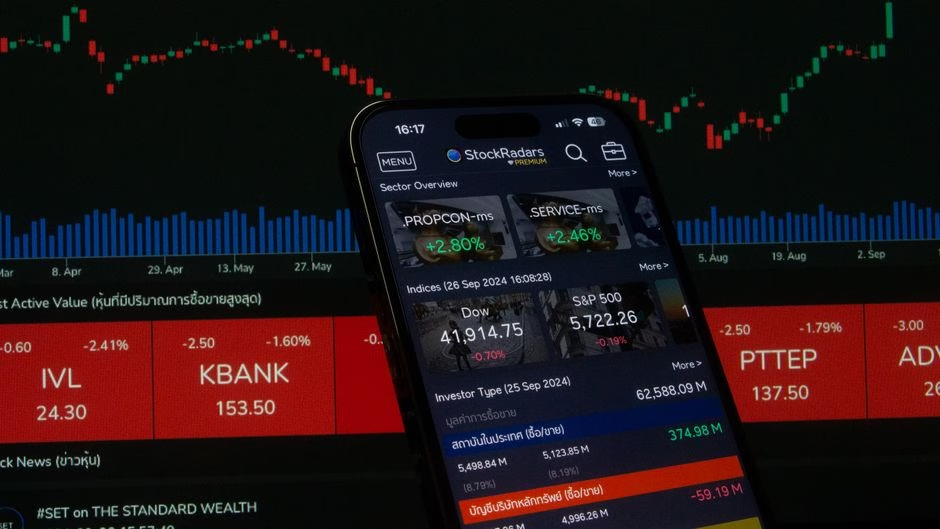
You’re scrolling through your brokerage app or checking Yahoo Finance during your lunch break, and you notice a stock ticker spiking in search volume. It’s all over the news, everyone’s talking about it, and suddenly you’re wondering: should I buy it? What’s actually happening here?
Right now, Maase Inc. (MAAS) is one of the most-searched stocks on Yahoo Finance among U.S. investors, even though—or maybe because—it’s down nearly 8% today and more than 10% over the past five trading days. This is the exact moment when understanding why stocks trend matters more than chasing the trend itself.
The good news: you don’t need to be a Wall Street insider to understand what drives investor interest in a stock like this. What you need is clarity on the mechanics—how news, earnings, sector trends, and even momentum can cause real price swings—and the wisdom to recognize when curiosity is healthy versus when it’s leading you down the path to a costly mistake.
Why Stocks Go Viral (And Get Searched on Yahoo Finance)
When a stock starts trending, it’s usually one of these reasons at play:
Earnings announcements. A company reports quarterly earnings that either beat or miss Wall Street expectations. If the miss is bigger than anticipated, the stock gets hammered. Investors search it to understand what went wrong and whether management’s forward guidance is still intact.
Sector news or macro events. Sometimes an entire industry gets hit by new regulation, rising interest rates, or supply chain disruptions. A single company’s stock may fall as part of a broader sell-off, but its individual search volume spikes because investors want to know if this particular business is vulnerable or resilient.
Insider activity or analyst downgrades. When an influential analyst cuts a price target or a company’s leadership suddenly sells stock, that news travels fast. Retail investors search the ticker to figure out what the smart money knows that they don’t.
Momentum and sentiment shifts. A stock that was a favorite among retail traders or a popular holding in certain investment communities can reverse sharply if sentiment flips. During sharp drawdowns, search volume typically increases because people want to decide whether to hold, sell, or buy the dip.
Short squeeze or liquidity events. Less common, but a highly shorted stock can gap down hard if bad news triggers a cascade of forced selling.
The key insight: search volume doesn’t tell you whether a stock is a buy or a sell. It tells you that something material changed or that investor sentiment shifted. That’s useful information, but it’s not an investment decision.
Understanding Price Movement: Fundamentals vs. Sentiment
Here’s where most casual investors get into trouble: they confuse a stock being heavily searched with a stock being a good opportunity.
A stock down 8% in a single day is probably experiencing one of these realities:
The fundamentals deteriorated. Actual business performance, guidance, or market conditions got worse. This is serious and often justifies a stock’s decline.
Sentiment reversed faster than fundamentals changed. A stock might have been “priced for perfection”—meaning investors had already baked in extremely optimistic expectations. Any hint that reality won’t match those expectations can cause a sharp selloff, even if the underlying business is still healthy.
Technical factors and volatility. If a stock has been on a hot streak, it may get hit by profit-taking. Low-volume stocks can also experience outsized percentage swings because the absolute number of shares trading is small. That 8% drop might represent far fewer dollars of selling than a 2% drop in a mega-cap stock.
The problem with searching a trending stock during a sharp drop is that you’re often making your decision in a moment of maximum uncertainty and emotion—both yours and the market’s. You might recall from similar situations that the wisest investors often do their homework before a stock starts trending, not after.
What Actually Drives Investor Interest in Stocks Like MAAS
Nasdaq-listed stocks, especially smaller-cap companies, tend to attract retail investor attention for specific reasons:
Accessibility and fractional shares. If you have a brokerage account, you can buy MAAS immediately, often with just dollars. There’s no friction, which means when retail investors get curious, they act fast.
Volatility creates opportunity—and noise. Smaller, less liquid stocks are more volatile. That volatility creates genuine trading opportunities for sophisticated investors, but it also creates a lot of false signals and emotional reactions for newer investors. A down 10% move in five days is dramatic enough to trigger searches.
Community and social talk. Stocks get discussed on Reddit, Twitter, and Discord channels dedicated to trading and investing. What starts as a conversation among a handful of engaged investors can amplify into broader awareness, especially if the stock is moving sharply.
ETF and institutional flows. If MAAS is held in popular ETFs or index funds, institutional rebalancing or sector rotation can move the stock even if there’s no company-specific news.
The reality: when a stock is trending and down significantly, it’s usually because something changed. But “something changed” doesn’t automatically mean it’s now cheap. It might be cheap. It might be fairly valued at the new price. Or it might be a value trap—a stock that looks cheap because it’s getting cheaper for good reasons.
The Real Risk: Chasing Trends Instead of Building a Plan
Here’s the mistake that costs people real money: buying a trending stock during a sharp drop because you feel like you’re “missing out” or because you assume the smart money is piling in.
Trending doesn’t mean fundamentally sound. A heavily searched stock is not the same as a well-researched stock. Search volume reflects curiosity and fear, not analysis.
Catching a falling knife hurts. A stock down 10% in five days might go down another 30% if there’s more bad news coming. You can’t know that from search volume alone.
Your actual returns depend on your entry point, not on the momentum. If you buy MAAS at $16.95 because it’s trending, and it falls to $12, you haven’t “bought the dip.” You’ve bought the dip that turned into a cliff. Meanwhile, if you’d waited six months and bought at $14 after doing real research, you’d be in a better position if the stock recovered.
The best investors typically approach a trending stock with disciplined questions:
- What are the actual earnings, revenue growth, and profit margins?
- Has the business model fundamentally changed, or did it just miss one quarter?
- What does the balance sheet look like? Can the company service its debt?
- What’s the valuation (P/E ratio, price-to-book, etc.) compared to peers?
- What’s the company’s position in its industry? Is it losing market share?
You don’t need to answer all of these perfectly. But asking them forces you to think like an owner of the business, not like a gambler hoping for a bounce.
How to Respond When You Notice a Stock Trending
Step 1: Don’t buy on the first day. Give yourself a cooling-off period of at least a few days. Let the initial shock settle and let real information emerge.
Step 2: Read the actual earnings report or news release. Not a headline, not a Reddit thread. The official source. What did management actually say about what went wrong and what’s ahead?
Step 3: Compare the valuation before and after the drop. Use free tools like Yahoo Finance, Morningstar, or Seeking Alpha to see the P/E ratio, forward guidance, and how the stock compares to competitors. Is it actually cheaper now, or just less popular?
Step 4: Ask yourself if you’d buy this stock if it went down another 30%. If the answer is no, you don’t really believe in it. You’re just hoping for a bounce. That’s speculation, not investing.
Step 5: Only invest what you’re truly willing to lose. If this is a smaller position in a diversified portfolio (say, less than 3-5% of your total stocks), the downside is capped. If you’re thinking about putting 30% of your portfolio into a trending stock, you’re not investing—you’re gambling.
The Real Lesson Behind Trending Stocks
The stock market is a machine for transferring wealth from the impatient to the patient. Every time a stock trends, it’s usually because impatient investors are reacting emotionally to news or price movement, while patient investors are quietly evaluating whether the price now reflects the company’s true value.
You don’t have to be a genius stock picker to do well. You just have to avoid the biggest mistakes: buying at the top because of FOMO, selling at the bottom because of fear, and letting social proof and trending tickers override your actual research and plan.
When you see a stock trending, your first instinct should be curiosity—not urgency. Take the time to understand why it’s moving, and only then decide if it belongs in your portfolio. Your future self will thank you for the discipline.
The next time you see a stock spiking in search volume, pause before you click “buy.” Ask yourself: am I investing, or am I reacting? That single question could save you thousands.