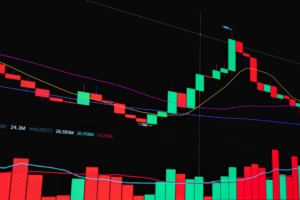
You’re scrolling through your brokerage app or checking Yahoo Finance and you see Applied Optoelectronics (AAOI) popping up everywhere. The stock is down hard today—nearly 17% in a single session—and investors are searching for it in droves. If you’ve noticed this and wondered what’s actually driving the interest, you’re not alone. When a stock makes a dramatic move like this, it’s worth understanding why it matters and what factors typically move shares in the semiconductor and optical components world.
This article breaks down what could trigger sudden price swings in a stock like AAOI, and how individual investors can learn to spot these patterns without getting caught up in panic selling or chasing gains. We’ll focus on education, not recommendations—because understanding the mechanics of stock price movement is far more valuable than reacting to a single day of volatility.
What Is Applied Optoelectronics, and Why Would It Trend?
Applied Optoelectronics (AAOI) manufactures optical and optoelectronic components and modules—essentially the specialized chips and components that enable data transmission in fiber optic networks, cloud data centers, and telecommunications infrastructure. This is a niche but critical corner of the tech world. When major cloud providers, telecom companies, or network infrastructure firms need high-speed data transmission solutions, AAOI is one of the suppliers they turn to.
This industry niche matters because it’s cyclical. Demand rises and falls based on broader tech spending trends, data center buildouts, and capital expenditure cycles. When a stock in this space makes a sharp move—especially downward—investors naturally want to know why. Was there bad earnings news? Did the sector face new headwinds? Is there a bigger slowdown coming? That search volume is what lands a stock on the “trending” lists you see on financial websites.
The Main Factors That Move Tech Supplier Stock Prices
Large single-day or multi-day stock declines rarely happen in a vacuum. Here are the typical triggers investors watch for:
Earnings Misses and Guidance Cuts
When a company reports quarterly earnings that fall short of what Wall Street expected, or when management lowers future guidance, the stock often sells off hard. For a supplier like AAOI, this could mean:
- Lower-than-expected orders from major customers
- Shrinking profit margins due to supply chain costs or competition
- Concerns that a key customer (like a hyperscale data center operator) is pulling back on spending
An earnings miss doesn’t always mean the company is broken long-term—but it can signal that near-term demand is weaker than expected, and that prompts immediate selling.
Sector and Industry Headwinds
Semiconductor and optical component suppliers are sensitive to broader tech spending trends. If there’s been a slowdown in data center construction, reduced capital spending by telecom companies, or macroeconomic uncertainty that makes large enterprises delay infrastructure projects, an entire sector can feel the pressure. When one stock in that sector drops sharply, others often follow, and investors search to understand what’s happening.
Major Customer News or Loss
A supplier’s stock can crater if there’s news that a major customer is shifting orders elsewhere, canceling a contract, or cutting their own spending plans. For companies in the optical components space, losing a significant data center customer can be material to the business.
Competitive or Technological Disruption
If a new competitor enters the market with better pricing, or if the technology landscape shifts in a way that makes AAOI’s products less necessary, that’s a genuine risk to the business. The optical networking world is competitive, and technological change can happen quickly.
Broader Market Sell-Off or Macro News
Sometimes a stock drops simply because the entire market is selling off, or because there’s negative macro news (interest rate concerns, inflation data, geopolitical events). Individual stocks get caught in these waves even if the company itself had no company-specific bad news.
Why Investors Search for Trending Stocks—And What That Means
When a stock is “trending” on financial sites, it usually means one of two things: the stock made a dramatic move (up or down), or significant news broke that caught retail investors’ attention. Investors naturally want to understand why before deciding what to do next.
Here’s what’s important to understand: Search volume doesn’t equal opportunity. In fact, high search volume on a stock that just dropped sharply often indicates panic or fear-based trading. By the time a stock is “trending” on Yahoo Finance, the initial move has usually already happened. If you’re seeing it trend downward, you’re often seeing the aftermath of a shock, not the beginning of a recovery.
Understanding Volatility Without Overreacting
If you own AAOI or are considering buying it after a sharp drop, here’s how to think clearly about it:
Separate the noise from the signal. A 17% single-day drop is alarming, but it doesn’t tell you whether the stock is a good buy or a bad hold. You need to know why it dropped. Did the company release bad news? Did the sector face a new headwind? Or did the broader market sell off and AAOI got caught in the wave? These require different responses.
Understand your own time horizon. If you’re a long-term investor (5+ years) in tech infrastructure, a sharp short-term drop might actually be a buying opportunity—or it might be a signal to re-evaluate the company’s competitive position. If you’re a short-term trader, volatility can be profitable or devastating depending on your skill and luck. Most retail investors should be focused on the long-term picture, not daily price swings.
Avoid the “trending stock” trap. Many casual investors buy or sell stocks precisely because they’re trending. This is often the opposite of smart investing. You want to buy quality assets when others are fearful, and avoid chasing momentum when everyone is excited. Trending stocks are usually the opposite of both.
How to Research a Stock After a Major Move
If you’re genuinely interested in understanding what happened to AAOI (or any stock making sharp moves), here’s a practical approach:
- Check for company news. Did the company issue a press release? Was there an earnings call? News releases from customers or competitors? This is your starting point.
- Review recent earnings and guidance. Look at the most recent quarterly results and management’s forward guidance. Did guidance change? Did margins compress?
- Look at the broader sector. Are other optical component makers or semiconductor suppliers also down? If so, it’s likely a sector issue, not a company-specific issue. For context on how broader sector trends move individual stocks, this look at renewable energy stock volatility covers similar dynamics.
- Check macro factors. What’s happening in the broader market and economy? Interest rates? Tech spending trends? Customer confidence?
- Read analyst reports. Major investment banks and research firms publish notes on stocks like this. They often provide context on whether a drop is an overreaction or a signal of deeper problems.
The Investor Lesson: Focus on Fundamentals, Not Trending Lists
Here’s what separates investors who build wealth from those who chase volatility: discipline. When a stock is trending downward, the instinct for many people is to panic-sell or desperately try to “catch the falling knife.” When a stock is trending upward, the instinct is to chase it hoping for quick gains.
Neither of these approaches typically works out well.
Instead, the smarter approach is to:
- Know what you own (or are considering owning). Understand the business, its competitive position, and its growth prospects.
- Have a plan before volatility hits. Decide in advance what would make you buy more, hold, or sell. Don’t let daily price swings make those decisions for you.
- Rebalance thoughtfully. If a stock drops because you made a mistake in your analysis, that’s a time to reconsider. If it drops because the market panicked, that might be a buying opportunity.
- Avoid checking prices obsessively. The more you look at daily moves, the more you’re tempted to react emotionally.
For most individual investors, the best long-term strategy isn’t picking individual stocks at all—it’s building a diversified portfolio of low-cost index funds and holding it through market cycles. But if you do pick individual stocks, understand the game: trending stocks are usually a sign that emotion is in control, not logic.
The Bottom Line
AAOI trending downward today tells you that investors are paying attention and searching for answers. It doesn’t tell you whether the stock is a good buy, a good sell, or irrelevant to your portfolio. A 17% drop is real and can reflect genuine problems, but it can also reflect momentary panic.
Your job as an investor is to look past the trending lists, understand what actually changed about the company or its industry, and make decisions based on facts and your own financial goals—not on the fact that thousands of other people are Googling the stock ticker.
Take 20 minutes today to identify the actual reason behind the move. If you own the stock, decide whether that reason changes your outlook. If you don’t own it, decide whether a sharp drop has made it more or less interesting to you. Then move on with your week—because the best investing decisions are rarely made in moments of peak emotion.