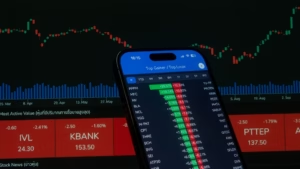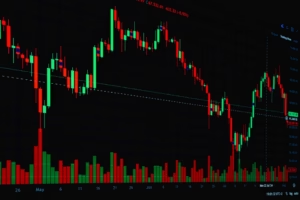
You’re scrolling through your brokerage app and notice SDEV (Stablecoin Development Corp) is exploding—up nearly 184% in a single trading session. Your phone is buzzing with alerts from friends asking if they should jump in. Before you do anything, here’s what you actually need to know about why stocks like this spike so dramatically, and what factors separate smart investing from gambling with your retirement savings.
This isn’t financial advice about whether to buy or sell SDEV. Instead, it’s a real conversation about how penny stocks and micro-cap companies trade, why they attract sudden investor attention, and the genuine risks that come with that territory. By the end of this article, you’ll understand the mechanics behind these wild moves—and more importantly, whether plays like this belong in your portfolio at all.
Why Certain Stocks Get Sudden Attention From U.S. Investors
When a stock moves 183% in a day, something has triggered retail investors and traders to pile in all at once. But here’s the critical point: that “something” doesn’t always mean the company just announced record earnings or landed a major contract. In fact, with penny stocks and very-small-cap companies, the reasons for explosive moves are often much murkier.
Sector tailwinds and broader crypto conversation. Stablecoin technology sits at the intersection of cryptocurrency adoption and institutional finance—two areas that generate intense debate and frequent headlines. When there’s a spike in general crypto news, renewed institutional interest in digital assets, or regulatory clarity around stablecoins, investors often do blanket searches for any publicly traded company with exposure to that theme. A company with “Stablecoin” literally in its name becomes a magnet for that search traffic.
Extreme low liquidity amplifies small moves. Here’s something most casual investors miss: penny stocks trade with far fewer shares changing hands each day compared to large-cap stocks. When a modest volume of buying pressure hits a stock with thin trading, the price can swing wildly—sometimes 50%, 100%, or more—just because there aren’t enough sellers at current prices. This isn’t necessarily bullish; it’s just how math works on an illiquid market. A $50,000 buying order in a penny stock can move the price much more than the same order in Apple or Microsoft.
Search volume and retail investor discovery. Yahoo Finance and other financial data sites track which tickers get the most searches from regular Americans on any given day. When a stock appears on a “most-watched” or “trending” list, it creates a self-reinforcing cycle: more people see it, more people search it, more people buy it, the price goes higher, and even more people notice. This feedback loop has nothing to do with the company’s actual business.
News, rumors, or SEC filings. Sometimes there’s a genuine news catalyst—a partnership announcement, a new management hire, a quarterly filing, or industry commentary. But in volatile microcaps, even neutral or mildly negative news can spark speculation. Traders sometimes buy on rumors before news is official, or they interpret ambiguous developments as bullish.
The Difference Between Catalyst and Cause
Here’s a practical distinction that matters for your portfolio: a catalyst is something that makes people want to trade a stock. A cause is something that actually makes the company more valuable.
For volatile penny stocks, catalysts are everywhere—social media chatter, a celebrity mention, a news headline you misread, an options expiration, or pure technical trading momentum. Causes are much rarer. They include things like:
- Consistent year-over-year revenue growth
- Expanding profit margins
- New products actually generating sales
- Winning major customer contracts with signed revenue
- Management changes that attract experienced operators
When a stock rises 183% in five trading days, it’s almost certainly riding a catalyst wave, not a fundamental cause. The danger is that catalysts fade just as fast as they appear. After the initial move, the stock often crashes back down as traders lock in gains and the hype evaporates.
Why Penny Stocks and Micro-Caps Are Riskier Than You Might Think
Like fintech stocks that attract attention from retail investors, penny stocks operate under different dynamics than established companies. Understanding those differences is crucial for protecting your savings.
Easier to manipulate and deceive. Stocks trading under $5 per share—especially on smaller exchanges—face less regulatory scrutiny and analyst coverage than large-cap stocks. A company can make bold claims about future products or partnerships with minimal accountability. Press releases can be vague or misleading without triggering immediate SEC enforcement. This creates more opportunity for fraud or honest misrepresentation.
No earnings track record to analyze. Many penny stocks are pre-revenue or early-stage companies with little to no profit history. When you buy Microsoft or Coca-Cola, you’re buying a stream of proven cash flows. When you buy a micro-cap, you’re buying hope and speculation. There’s no financial foundation to stand on.
Extreme volatility eats at your wealth. A stock that goes up 183% can also go down 80%, 90%, or even to zero. If you buy at the peak of hype and it crashes 85%, you’ve lost most of your money. Volatility itself—the wild swings—isn’t wealth creation; it’s just noise and opportunity for losses.
Bid-ask spreads are wider. On liquid stocks, the difference between the buy price and sell price is tiny—sometimes just a penny. On penny stocks, that spread can be 5%, 10%, or more. You might buy at $3.66, but you’ll have to sell at $3.50 just to find a buyer. That invisible cost eats into your returns.
Lower institutional ownership. Big pension funds, mutual funds, and endowments avoid penny stocks because of compliance rules and fiduciary responsibility. When the only buyers are retail traders and speculators, there’s no stable base of support for the stock price.
What Moves Stocks Like This (And What Doesn’t)
To think clearly about whether to own SDEV or any penny stock, you need to separate real drivers from noise:
Real drivers that warrant research:
- Regulatory changes that genuinely affect the company’s market opportunity
- New partnerships or contracts with verifiable revenue impact
- Management changes bringing proven operators from successful companies
- Quarterly earnings that beat expectations with growing revenue
Noise that drives short-term hype but doesn’t create value:
- General sector trends unrelated to this specific company
- Social media mentions or Reddit threads
- Stock price momentum itself (“it’s up so it must be good”)
- Comparison to bigger, more successful competitors in the space
- FOMO (fear of missing out) from friends or online communities
The honest truth is that for most penny stocks, you can’t distinguish between the two without deep research into SEC filings, management backgrounds, customer contracts, and competitive positioning—work that most retail investors don’t have time for. And even with that work, you’re making an educated guess, not a confident investment decision.
How to Think About Penny Stocks in Your Overall Portfolio
If you’re building real long-term wealth for retirement, a home down payment, or other meaningful goals, penny stocks don’t belong in the core of your portfolio. Here’s why:
Your core holdings should be boring, diversified, and predictable. Index funds, Roth IRAs, 401(k)s, and steady blue-chip stocks compound over decades because they’re not dramatic. Penny stocks are the opposite—they’re exciting, unpredictable, and most people lose money on them.
If you want to speculate with penny stocks, follow these guardrails:
- Only use money you can afford to lose completely—never borrowed money, never retirement savings, never money earmarked for bills or emergencies
- Keep the total allocation tiny—ideally under 5% of your overall investable assets, and for many people, 0% is the right answer
- Never buy based on hype or FOMO; research the actual company first
- Set a stop-loss (a price at which you automatically sell) so you don’t hold onto losses hoping for a rebound
- Understand that you’re gambling, not investing—and be honest with yourself about that
For most Americans, the math of wealth-building doesn’t involve penny stocks. A $500 investment in a boring S&P 500 index fund, reinvested for 30 years at 10% annual returns, becomes roughly $8,700. That same $500 in a penny stock that goes to zero? Gone. And the penny stock that goes up 10x? Fantastic—but the odds are stacked heavily against you, and one big loss wipes out many small wins.
The Real Question to Ask Yourself
Before you click “buy” on SDEV or any trending penny stock, ask yourself this: Do I understand the business well enough to explain it to a friend, and do I believe in it five years from now? If the answer is “no, I just saw it was up 183% today,” then you already know what you should do.
Investing works best when it’s boring. Building wealth happens through consistent contributions to diversified portfolios, not through hunting for the next moonshot. The investors who end up rich aren’t the ones chasing viral stock picks—they’re the ones who max out their 401(k)s, dollar-cost average into index funds, and let compound interest do the heavy lifting.
You have plenty of time to build wealth the slow, reliable way. That’s where your energy belongs.