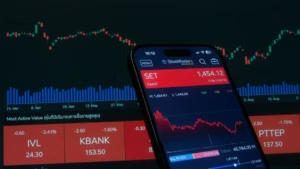

You open your phone during lunch break, and your news feed is flooded with stock market headlines. Friends are texting about their portfolios. Your coworker mentions the market’s wild swings. You’re not alone—”stock market news today” is one of the top trending searches right now, and millions of Americans are frantically checking their accounts.
Here’s the thing: paying attention to daily market movements is natural, but it can also be dangerous to your long-term wealth if you don’t understand what’s actually happening and how to respond (or, more often, how not to respond). The good news? You don’t need to become a financial analyst to make smart decisions when the market gets noisy.
Let’s break down why market news spikes in search volume, what it usually means, and exactly how you should handle it as someone building real wealth.
Why “Stock Market News Today” Trends When It Does
Market news searches spike for predictable reasons, and understanding them helps you stay calm when volatility hits.
Major economic data releases typically drive interest. When the Federal Reserve announces interest rate decisions, inflation reports drop, or jobs numbers come in unexpectedly, millions of people naturally want to know what it means. These moments feel urgent—like you need to act immediately.
Significant stock movements also trigger searches. When the S&P 500, Nasdaq, or Dow Jones swings 2–3% in a single day, people get nervous. A 3% drop feels massive when you’re looking at real money in your 401(k) or brokerage account.
Company-specific news creates smaller waves of searches. When a major tech stock drops 10% or a household-name company has earnings miss expectations, that ripples across search trends as people dig for context.
Election cycles, geopolitical events, and recession fears also drive consistent search spikes throughout the year.
The underlying pattern is always the same: uncertainty makes people search for answers. Your brain is doing exactly what it’s supposed to do—seeking information when something feels risky. But here’s where most people stumble: they search, they read conflicting opinions, they panic, and they make moves they later regret.
The Real Cost of Chasing Daily Market News
Before you spend your evening doom-scrolling market updates, understand what research actually shows about frequent stock checking.
Studies consistently show that people who check their portfolios daily trade more often, and traders underperform buy-and-hold investors. This isn’t because frequent checkers are dumb—it’s because constant visibility creates a feeling that you should be doing something. When you see your balance down $2,000, your brain activates the same stress response as seeing a predator. It’s evolutionary. But selling during a dip is how people crystallize losses and miss the recovery.
Active traders also face higher fees and taxes, which quietly destroy returns over decades. Every trade in a regular brokerage account can trigger capital gains taxes. Every trade in any account involves commissions or spreads. Over 20 years, a portfolio that trades frequently can end up 30–50% behind an identical buy-and-hold portfolio, even if the individual stock picks were sound.
Time is the real cost. Checking market news daily takes mental energy. It creates stress that bleeds into your work and personal life. It makes you feel like you’re “managing” your money when you should be managing your strategy instead.
The paradox: people who check the least often tend to retire with the most.
How to Stay Informed Without Becoming Obsessed
You still need to pay attention to your finances—but smart investors separate “staying informed” from “panic scrolling.”
Set a quarterly review schedule instead of daily checks. Mark your calendar for the first Saturday of every quarter (January, April, July, October). Spend 30 minutes reviewing your portfolio performance, rebalancing if necessary, and adjusting your strategy if life circumstances changed. This gives you enough information to make good decisions without the daily noise.
Follow the macro story, not the daily wiggles. Instead of reading that Netflix dropped 2% today, ask bigger questions: Are interest rates rising or falling? Is the overall economic trend solid or weakening? Are unemployment claims trending up or down? These patterns matter. Daily stock prices don’t. When major economic shifts happen, financial publications will cover them with depth you can understand in a few minutes.
Use news as a filter, not a signal. If you see a major story—say, a Fed rate decision—read the explanation once to understand what happened and why investors reacted. Then close the app. You don’t need to read 47 different takes on the same announcement. More information doesn’t lead to better decisions; it leads to decision paralysis.
Unsubscribe from push notifications. Seriously. Go into your phone settings right now and disable market alerts. The only alerts worth receiving are ones you specifically set up for quarterly rebalancing reminders or when you’re actively selling shares. Remove the friction that keeps you continuously engaged.
What Actually Matters More Than Today’s Market News
While everyone’s focused on what the market did today, consider what actually drives your wealth over 20–30 years.
Your savings rate dominates your returns. If you’re saving an extra $500 per month into your 401(k) or IRA, that decision will move your net worth more than whether the market goes up or down 2% this week. A 3% market dip might temporarily reduce a $100,000 portfolio by $3,000. But if you increase contributions by $500 monthly, you’re adding $6,000 annually—which compounds to real money. Focus there.
Asset allocation matters far more than stock picking. Whether you own Apple or Microsoft matters less than whether your overall portfolio is 80% stocks and 20% bonds versus 60% stocks and 40% bonds. Your asset allocation should match your age, risk tolerance, and time horizon—and then stay relatively stable. When people panic-sell during market dips, they usually sell their stock holdings (which are down) and hold cash or bonds (which are stable). This locks in losses and derails their long-term allocation. The people who get rich from the stock market usually aren’t trying to time it—they’re rebalancing toward stocks when they’re cheap.
Time in the market beats timing the market. Someone who invested $10,000 on January 1st of the single worst year in stock market history (2008) and never touched it would be up around 300% by now. Someone who invested $1,000 every month starting in 2008 and never missed a month would be up even more. The key: they didn’t try to be clever. They stuck to the plan.
Your behavior under stress is the actual skill. The people who become wealthy aren’t necessarily smarter or luckier—they’re disciplined enough to follow a plan when it feels wrong to do so. You will have days where the market drops and you feel panicked. That’s when your real investing skill shows up: staying calm and remembering why you have a long-term strategy.
When You Actually Should Pay Attention to Stock Market News
This isn’t “never read the news”—it’s “read it strategically, not reactively.”
Pay attention if major economic conditions shift. If unemployment suddenly spikes, or if the Fed signals it’s about to cut rates dramatically, that might mean you should adjust your strategy—but it should take weeks to think through, not minutes. For example, if you’re holding 100% stocks at age 65 and a recession looks imminent, shifting to 60% stocks and 40% bonds might make sense. But this decision takes time and usually should involve a fee-only financial advisor, not a panic decision at 10 p.m. on a Wednesday.
Pay attention to changes in your personal situation. Market news becomes relevant when it intersects with your life. If you’re planning to buy a house in two years and the market just dropped 20%, suddenly your timeline matters. You might move that down payment money to safer investments. But again—this is a personal decision, not a market-timing decision.
Pay attention if you’re about to make a major financial move. If you’re about to invest $50,000 of inheritance money, understanding current market valuations and your own goals matters. If you’re switching jobs and rolling over a 401(k), reviewing your investment options while thinking clearly (not during a market panic) is smart. These are planning moments, not reaction moments.
But the daily market news? The headlines? The analyst predictions? You can skip all of that and still become very wealthy.
Your Move Today
The next time you feel the urge to check stock market news, ask yourself this: “Would knowing this information change any decision I’m making in the next 24 hours?” If the answer is no—and it almost always is—scroll past it.
Instead, if you haven’t done so already, schedule that quarterly portfolio review. Set a recurring calendar reminder. Commit to checking your investments every three months, not every three minutes. In the meantime, focus on the only things that actually move your wealth: saving more, staying invested, and sticking to a plan.
The boring truth about getting rich is that it’s boring. The people who read endless market news and trade constantly are the ones with exciting stories but underwhelming portfolios. The ones who get wealthy are the ones who seem boring to their friends because they don’t talk about the market at all.
If everyone you know is obsessing over today’s market news, you’ve found your competitive advantage: just ignore it and stay the course.
What’s one change you’re making to reduce how often you check market news—a notification you’re disabling, or a calendar reminder you’re setting? Drop your answer in the comments.