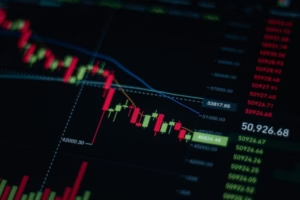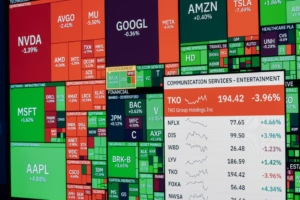
You open your brokerage app on a busy weekday afternoon, expecting to see the usual steady numbers, only to notice red text across your screen. The Vanguard S&P 500 ETF (ticker symbol VOO) is hovering near $701 per share, posting a drop of nearly 2% in a single session and capping off a multi-day slide. Because VOO is one of the most widely held funds in retirement accounts across America, even a minor dip turns it into one of the most searched stock tickers on financial portals overnight.
When a massive index fund stumbles, newer investors often wonder whether something is fundamentally wrong with the economy or if a larger crash is looming. In reality, short-term pullbacks are a routine feature of the equity markets. Understanding the mechanics of buying voo during a market dip for long term investors can help you cut through the market noise, convert market anxiety into disciplined strategy, and keep your long-term wealth building on schedule.
In this guide, we will break down what drives VOO’s price movements, why short-term drops happen, and how smart investors handle market pullbacks without making emotional mistakes with their money.
—
What Is VOO and Why Does It Lead Financial News?
Before analyzing market price swings, it is helpful to understand what VOO actually represents. Issued by Vanguard, VOO is an exchange-traded fund designed to mirror the performance of the S&P 500 Index. When you buy a single share of VOO, you are not betting on one company’s success; you are instantly purchasing a tiny slice of 500 of the largest publicly traded corporations in the United States.
Here is why VOO serves as the default building block for millions of U.S. portfolios:
- Ultra-Low Expense Ratio: VOO carries an annual expense ratio of just 0.03%. That means for every $10,000 you invest, Vanguard takes only $3 per year in management fees, allowing virtually all of your growth to compound in your account.
- Market-Cap Weighting: The index gives heavier weight to larger corporations. Tech giants like Apple, Microsoft, NVIDIA, Amazon, and Alphabet account for a substantial percentage of the fund’s total performance.
- Instant Diversification: Instead of taking on single-stock risk, VOO spreads your dollars across technology, healthcare, financial services, consumer goods, and industrial sectors.
Because VOO represents roughly 80% of the total available U.S. stock market capitalization, any shift in its price is essentially a real-time report card on American big business. When VOO drops 2%, it isn’t an isolated event—it reflects broader shifts across the entire U.S. financial landscape.
—
The Core Factors That Move VOO’s Price Daily
Because VOO is a basket of 500 stocks, individual corporate announcements rarely push the fund on their own unless they come from the absolute largest companies. Instead, macroeconomic trends and sector-wide news tend to dictate whether VOO ends the day in the green or the red.
1. Corporate Earnings from Sector Giants
Because VOO is market-cap weighted, the largest companies carry outsized influence over the fund’s price. If major technology firms report earnings that miss Wall Street expectations or offer conservative forward guidance, their stock prices drop. Given their heavy weighting inside the S&P 500, a tough day for top tech stocks can drag the entire ETF down, even if companies in healthcare or utilities had a strong day.
2. Federal Reserve Interest Rate Signals
The Federal Reserve’s decisions regarding interest rates are primary drivers of market volatility. When the Fed signals that interest rates will stay higher for longer to combat inflation, corporate borrowing costs remain elevated. Higher rates tend to cool economic expansion and lower stock valuations across the board, triggering broad pullbacks in major index funds like VOO.
3. Economic Data and Inflation Reports
Key reports—such as the Consumer Price Index (CPI), Monthly Jobs Reports, and Gross Domestic Product (GDP) updates—give investors a window into economic health. Stronger-than-expected inflation data can spark fears of future rate hikes, while weaker-than-expected economic growth raises concerns about a cooling economy. Both scenarios can prompt investors to sell equities in the short term, leading to quick 1% to 3% market pullbacks.
—
The Psychology of Red Days: Index Funds vs. Individual Stocks
When single-company stocks fluctuate wildly, investors have to evaluate company-specific risks like bad management decisions, regulatory changes, or declining product sales. Contrast that with broad market funds: unlike speculative stock bets or viral market crazes—which we explored when discussing when celebrity trends meet your portfolio—a broad index fund like VOO does not rely on hype or single-product success.
Similarly, while income-focused investors monitor individual cash-flow generators like AT&T stock during market pullbacks, index investors view VOO as a mirror of the whole domestic economy.
When VOO pulls back by 1.8% or 2% over a week, history shows this is rarely a sign of structural failure. Instead, it is typically a short-term repricing as institutional investors rebalance their capital. For long-term investors aiming for retirement, a falling index price means top-tier American businesses are essentially selling at a brief discount compared to their recent high prices.
—
4 Smart Strategies for Handling Market Pullbacks
If seeing red in your account makes you nervous, establishing a rules-based strategy helps remove guesswork and emotion from investing. Here are four practical strategies to manage market pullbacks effectively.
1. Automate Your Investing with Dollar-Cost Averaging (DCA)
Trying to timing the absolute bottom of a market drop is virtually impossible, even for professional traders. A dollar-cost averaging strategy solves this problem by investing a set amount of money at regular intervals—such as $200 every payday—regardless of whether the market is up or down.
When VOO is rising, your fixed dollar amount purchases fewer shares at higher prices. When VOO experiences a dip, that same dollar amount automatically buys more shares at a lower cost per share. Over decades, this practice smooths out your average purchase price and eliminates the stress of guessing when to buy.
2. Take Advantage of Fractional Shares
At a price point around $700 per share, purchasing full shares of VOO on short notice can feel daunting for everyday investors. Fortunately, most major U.S. brokerages—including Fidelity, Charles Schwab, Vanguard, and Robinhood—now offer fractional share trading.
You do not need $700 sitting in cash to capitalize on a market pullback. You can buy $25, $50, or $100 worth of VOO on any given trading day. Fractional shares enjoy the exact same percentage gains and dividend yields as full shares, making market dips accessible regardless of your current budget.
3. Prioritize Tax-Advantaged Accounts First
If you decide to allocate more cash during a market drop, make sure you are directing those dollars into the right account structures to minimize tax drag over time:
- Employer 401(k) or 403(b): Ensure you are contributing at least enough to capture any full employer matching funds—that is an immediate 100% return on your money.
- Roth IRA: For 2024 and 2025, eligible individuals can contribute up to specified IRS limits into a Roth IRA. Contributions grow completely tax-free, and qualified withdrawals in retirement are 100% tax-free.
- Health Savings Account (HSA): If you hold a high-deductible health plan, an HSA offers a unique triple-tax advantage for long-term investing if left to grow over time.
Once you have maximized your tax-advantaged buckets, open taxable brokerage accounts can handle any remaining investment funds.
4. Maintain a Dedicated Emergency Cash Reserve
The biggest risk during a stock market drop is being forced to sell your investments at a loss because you need cash for an unexpected expense. Before putting extra cash toward index funds during a pullback, ensure you hold three to six months of living expenses in a high-yield savings account (HYSA). Having a reliable cash cushion lets you leave your VOO investments untouched during volatile market cycles.
—
The Common Pitfall to Avoid: Trying to Time Market Bottoms
The single biggest mistake everyday investors make during a pullback is sitting on the sidelines, waiting for the stock market to drop further before buying—or panic-selling shares out of fear that a dip will turn into a crash.
Financial market history demonstrates two critical realities:
- Market Timing Is Unreliable: Pullbacks can reverse suddenly. The market’s strongest performance days frequently happen immediately following steep down days. If you sell during a dip or wait too long to re-enter, you risk missing these sharp rebounds.
- Missing Top Days Destroys Compound Growth: J.P. Morgan Asset Management analyzed decades of S&P 500 returns and found that missing just the 10 best trading days over a 20-year period cut an investor’s total final returns roughly in half.
Sitting on excessive cash while waiting for the “perfect” moment to buy often leads to buying back in after prices have already rebounded to new record highs.
—
How to Take Action with Your Portfolio Today
If you are tracking VOO’s latest movement and deciding how to handle your money, here is a practical, step-by-step checklist to keep your financial goals on track:
- Review Your Investment Horizon: Money needed within the next three to five years (such as a house down payment or wedding fund) belongs in high-yield savings accounts or short-term CDs, not in broad market index ETFs.
- Automate Contributions: Set up recurring transfers from your checking account to your investment broker on your paydays to automate dollar-cost averaging.
- Check Your Asset Allocation: Ensure your overall portfolio split between equities, bonds, and cash matches your personal risk tolerance and age profile.
- Turn Off Daily Notifications: If short-term price fluctuations make you anxious, log out of your brokerage app. Long-term wealth is built over decades, not days.
Market volatility can feel unsettling in the moment, but for disciplined, long-term investors, routine dips in total-market funds like VOO are simply part of the journey toward financial independence.
What is your strategy when major index funds experience a pullback—do you keep your automatic contributions running, or do you step in with extra cash? Let us know in the comments below!